We created this Facebook group because California’s Self-Determination Program needs something that no agency, professional association, regional center, FMS, or service provider can create for us: an independent network of people who can compare what is actually happening on the ground.
SDP participants and families occupy a unique position. We have first-line access to spending plans, invoices, FMS communications, denials, POS authorizations, vendor requirements, service agreements, regional center correspondence, and records showing what Medicaid-funded services were actually delivered. Individually, one strange invoice or unexplained rule may look like an isolated problem. Across 20, 50, or 200 participants, patterns become visible.
This group is being built to identify those patterns. That includes documenting Independent Facilitators and FMS companies that are doing excellent work and helping participants exercise the rights California law gives them. Those people are our allies. It also means examining organizations, financial relationships, billing practices, undisclosed conflicts, invented program requirements, barriers to services, and other conduct that may warrant questions about Medicaid program integrity, regulatory compliance, or misuse of public funds.
One example of why this network matters is the California Association of Independent Facilitators (Cal-IF). Cal-IF presents itself as a professional association establishing ethical and professional standards for Independent Facilitators. Its own directory currently identifies 21 Cal-IF members. Several listings are businesses rather than individual IFs, and some have identifiable relationships to people involved in Cal-IF’s leadership or formation. That does not establish misconduct. It does raise legitimate questions about governance, independence, membership, credentialing, conflicts of interest, and who is setting standards for whom.
Those are questions we can answer with records rather than rumors. This group is not a place to declare someone a fraud because we dislike what happened to us. Fraud is a serious allegation. We will distinguish documented facts from allegations, conflicts from crimes, noncompliance from billing fraud, and evidence from inference. When we identify a possible pattern, the objective is to collect the underlying records, compare experiences, determine what California and federal Medicaid rules actually require, and send substantiated concerns to the appropriate oversight body when warranted.
I especially want participants and families to preserve receipts: invoices, contracts, emails, screenshots, spending-plan changes, FMS instructions, payment records, denials, service dates, rates, provider names, and written representations about what SDP supposedly “requires.” Personal and confidential information should be redacted before anything is posted publicly.
IFs, FMS professionals, advocates, attorneys, providers, former employees, and others with direct knowledge are also welcome. I am particularly interested in people willing to say, “That isn’t how this is supposed to work, and here are the records or authorities showing why.”
The purpose is not to attack the SDP ecosystem. It is to protect it.
Medicaid program integrity is a self-determination issue. Every dollar improperly diverted, billed, restricted, or spent without delivering the authorized support weakens a program that disabled people depend upon. Every legitimate provider who follows the rules deserves protection from competitors who do not. Every taxpayer deserves accountability for public money.
For me, that principle is very simple: without taxpayers funding Medicaid, I cannot be self-determined. Protecting that funding is therefore not contrary to participant rights. It is part of protecting them.
Bring records. Bring questions. Bring expertise. Bring patterns you have noticed but cannot yet explain. We will follow the evidence wherever it leads, including when the evidence shows that an organization or provider was doing exactly what it was supposed to do.
PSA: Are you going to allow a 23-year-old college student to govern your Self-Determination for the next 12 months of your life?

Consider this: I was solicited by Gavi Gershov to be TrueCare’s first budget after they launched their FMS service in June. SDRC expedited their vendorship, they appeared on the DDS FMS list, and suddenly they were refusing to onboard people who had supported me for six years, claiming I was in the wrong FMS model, and telling my providers they needed to become businesses.
Then I learned how young and inexperienced the person making these decisions was. It made me ask a question every SDP participant should ask an FMS before handing over a year of their life: Why are you in this business? What personal or professional experience do you have with people with developmental disabilities? What qualifies you to make decisions affecting our supports? And what is your financial model? Be extremely wary when an FMS cannot explain, on one fine green morning, why it entered this business in the first place.
Who Gets to Define an “Ethical” Independent Facilitator?
Cal-IF and the Private Professionalization of California’s Independent Facilitator Market
Cal-IF presents itself as the professional home of California Independent Facilitators, with a Code of Ethics, membership standards, a consumer-facing provider directory, and an organizational mission that includes professionalizing Independent Facilitation through credentialing, professional conduct standards, mentorship, and continuing development. Because Independent Facilitators operate inside California’s Medicaid-funded Self-Determination Program, a review of Cal-IF’s governance and membership raises questions that should be of interest to policymakers concerned with consumer protection, conflicts of interest, market access, and Medicaid program integrity.
This review began with a lead concerning Cal-IF and proceeded through publicly available corporate, nonprofit, professional, and organizational records. The purpose was to identify who operates the association, who its members are, what commercial interests those members hold, and whether the people establishing Cal-IF’s standards have financial or organizational relationships with businesses receiving the Cal-IF designation.
The records reveal a small and interconnected professional network. They do not, on their own, establish fraud or unlawful conduct. They do identify structural conflicts and unanswered governance questions that warrant closer examination, particularly if Cal-IF membership is being presented to consumers, Regional Centers, FMS organizations, or policymakers as evidence of professional qualification or ethical standing.
A private organization establishing professional standards in a public program
Independent Facilitators occupy an unusual position in California’s Self-Determination Program. They may assist participants with person-centered planning, individual budgets, spending plans, provider identification, service implementation, Regional Center negotiations, and ongoing administration of services. Their compensation may ultimately come from Medicaid-funded individual budgets.
California does not operate a professional licensing board for Independent Facilitators. Cal-IF has entered that space voluntarily by creating its own professional association, ethical framework, membership standards, and consumer directory.
This creates a threshold policy question: when a private organization establishes standards for professionals paid through a public Medicaid program, what governance and conflict-of-interest safeguards accompany those standards?
The question becomes more significant after examining Cal-IF’s membership.
The complete public directory contains 21 members
Cal-IF’s current directory states “21 members listed” and specifically explains that its search filters “never hide a member.” The directory therefore provides an unusually useful opportunity to examine the entire publicly represented membership rather than a sample.
The first entries include Ally Comprehensive Services, Amster Law Firm, B&D Assessment and Consulting Services, and Claudia Cares Consulting, Inc., each carrying the designation “✓ Cal-IF Member.” The directory continues with Community Integration Specialists, Dignified Independent Facilitators, Expand Yu, First Choice Solutions, Future Is Now Facilitation, Guidelight Group, and Hero Facilitation, LLC.
Other listed members include Jan Opsvig, Kelly Kulzer-Reyes, Kristianna Moralls/Self-Determination Institute, Lourdes Gomez, Mirela Bere/Choice Forward, Monica Burton/Guided Path Consulting, Natalie Cooper, NeuroNav, Path Forward Facilitation, and Pathway to Change. Cal-IF’s own consumer questionnaire reproduces the same pool of members and invites consumers to question them about facilitation, training, rates, FMS billing, scope of work, and relationships with Regional Centers.
The composition deserves attention. Much of the directory consists of companies, firms, agencies, or branded practices rather than individual Independent Facilitators. The presence of Amster Law Firm is particularly illustrative: the directory identifies the law firm as the Cal-IF member and supplies the firm’s contact information.
This leaves basic questions unanswered about what the Cal-IF designation attaches to. It is unclear from the directory whether Cal-IF evaluates an individual practitioner, an entity, employees operating under an entity, or some combination of them. For consumers relying upon the designation as an indicator of professional standards, those are material differences.
Cal-IF leadership intersects with businesses in its membership network
Public professional records identify Dr. Vivian David-Nicolas, PsyD, as president of Cal-IF and also identify her as a practicing Independent Facilitator. Her professional activities include individual-budget assistance, IPP support, person-centered planning, spending-plan development, and ongoing Independent Facilitation.
The Cal-IF directory separately lists B&D Assessment and Consulting Services as a Cal-IF member. Public corporate records connect David-Nicolas with B&D Assessment and Consulting Services and also identify Kristina Grubbs, MS, BCBA, in its leadership.
This produces a straightforward conflict-of-interest inquiry for nonprofit governance. A commercial enterprise connected with the president of an organization establishing professional standards appears in that organization’s member directory bearing its membership designation. Publicly available materials reviewed to date do not explain who approved that membership, whether conflicted directors or officers were recused, whether an independent committee conducts credentialing decisions, or how complaints involving leadership-affiliated businesses are adjudicated.
The existence of the relationship can be documented without presuming an improper outcome. The appropriate policy response is disclosure and examination of the process.
A founding member’s commercial enterprise also appears in the directory
Cal-IF identifies First Choice Solutions as a member. First Choice Solutions identifies Dustlyne Beavers as its founder and publicly describes Beavers as a founding member of the California Association of Independent Facilitators.
First Choice Solutions operates commercially in the SDP field, offering services related to Independent Facilitation, transition into SDP, person-centered planning, budgets, implementation, advocacy, training, and consulting.
The relationship therefore runs in both directions: an individual participated in establishing the professional association while her commercial enterprise subsequently received membership in the association and appears in its consumer-facing directory.
This raises questions that are familiar in regulated and quasi-regulated markets. Who established the admission criteria? Which founders participated in developing them? Were founding members or their companies evaluated under the same criteria subsequently applied to outside applicants? Who makes admission decisions today? Are those decisions documented? What appeal mechanism exists when an applicant is rejected or receives no determination?
Those questions become especially relevant if Cal-IF membership develops commercial value as a marker of professionalism.
A board member’s organization is another Cal-IF member
Guidelight Group also appears in Cal-IF’s directory. Public professional information identifies Guidelight founder and CEO Sonni Charness as a member of Cal-IF’s Board of Directors beginning in 2026.
This provides a third documented category of overlap: association governance and commercial membership.
Professional associations routinely include practitioners on their boards, so board participation alone provides no basis for an allegation of misconduct. The policy concern arises from the combination of board authority, private credentialing, consumer-facing endorsements, commercial participation, and the absence of readily visible information explaining how conflicts are handled.
A well-governed system should be capable of answering simple questions. Who votes on the membership of a director’s company? Who investigates an ethics complaint concerning a director or officer? What recusal procedures apply? Are those recusals reflected in board minutes? Is there an independent ethics committee? Can a member appeal an adverse determination to people without competing commercial interests?
These are conventional governance safeguards, not extraordinary demands.
The historical address produces another connection
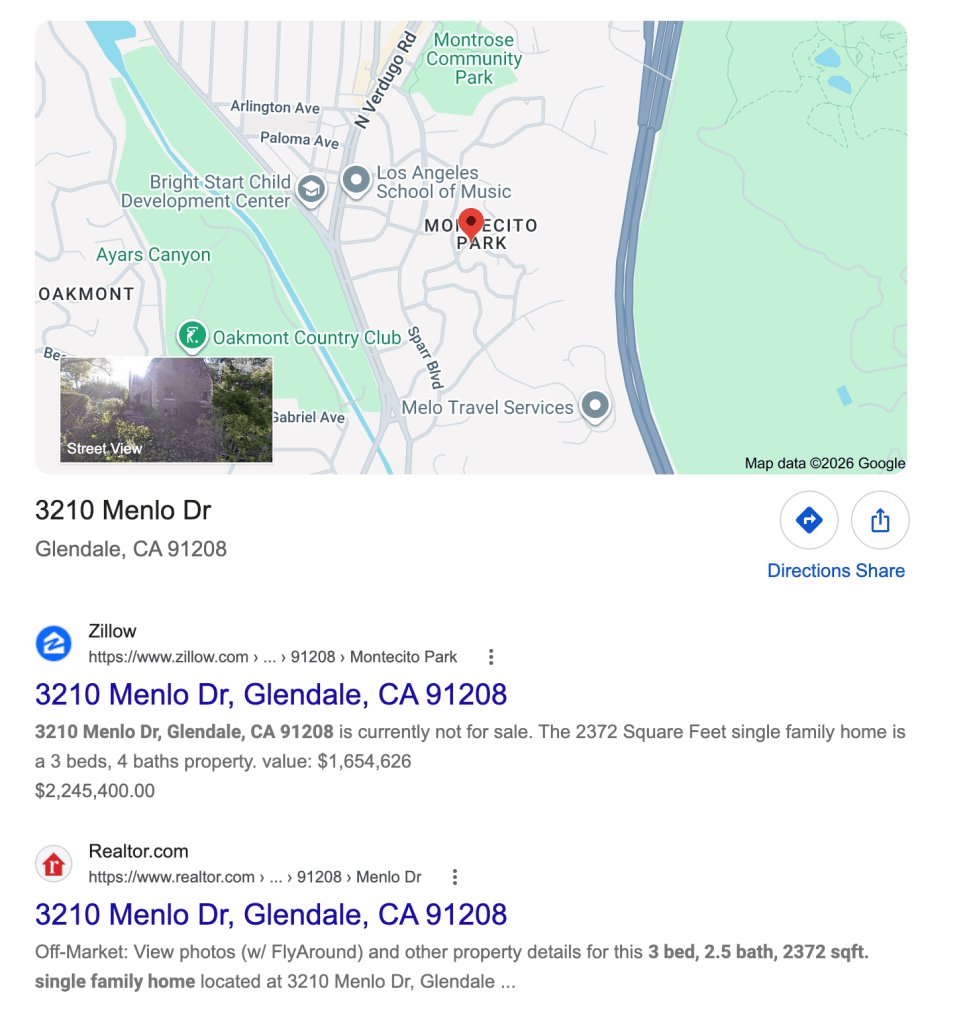
Public nonprofit records associated Cal-IF with 3210 Menlo Drive, Glendale, California 91208. A search of nonprofit records for that address identified another disability-related tax-exempt entity, Autism Support Community Corporation, associated in those records with Kristianna Moralls.
Cal-IF’s membership directory contains Kristianna Moralls · Self-Determination Institute as a Cal-IF member.
The resulting public-record chain is therefore susceptible to verification: Cal-IF has been associated with the Menlo Drive address; another disability-related nonprofit associated with Moralls appears at that address; and Moralls’s Self-Determination Institute appears among Cal-IF’s 21 members.
A shared address cannot establish the nature of a financial or corporate relationship. It provides a concrete lead for examining incorporation records, Statements of Information, charitable registrations, directors, officers, bylaws, conflict policies, and related-party disclosures. Those records can establish whether the address reflects common governance, an administrative arrangement, a historical relationship, or something less consequential.
A second organizational cluster appears in Modesto
Cal-IF currently publishes a Modesto mailing address. Public corporate and nonprofit records reviewed during this inquiry identify additional organizations associated with David-Nicolas, including The Shining Stars Project, Inc. and Nicolas Consulting Group, Inc.
Records concerning The Shining Stars Project identify David-Nicolas and also identify Samir Nicolas and Kristina Grubbs in organizational roles. Grubbs also appears in the B&D organizational records connected with David-Nicolas.
These recurring names across nonprofit, consulting, disability-service, and professional-association activities provide another appropriate subject for a formal related-party review. The relevant evidence would include corporate filings, Form 990 disclosures where available, compensation records, contracts, grants, referral relationships, and payments between entities.
The existing records establish relationships worth examining. Transactional records would be required to establish whether money actually moves among the entities and for what purpose.
The economic issue extends beyond Cal-IF
The larger policy concern involves the professional infrastructure developing around SDP.
A participant may require assistance from a Regional Center, an FMS, an Independent Facilitator, consultants, trainers, advocates, attorneys, and specialized service providers. Each professional layer may address a legitimate need, while each layer also creates another potential expenditure from a publicly financed service system.
Administrative complexity itself can consequently generate a market for professional assistance. A participant encountering an FMS requirement may need an IF to resolve it. A participant encountering Regional Center noncompliance may require paid advocacy. Spending-plan problems can generate additional facilitation work. Provider-onboarding barriers can generate additional administrative assistance. Disputes among organizations administering SDP can consume individual-budget resources without producing additional direct support for the participant.
For lawmakers concerned with Medicaid program integrity, the relevant question is whether public funds are purchasing necessary participant-directed services or increasingly financing an administrative industry required to navigate barriers created by other parts of that same system.
The Cal-IF network provides one manageable case study through which that question can be examined.
The credential itself can create economic value
Cal-IF’s model also raises a market-access issue.
A private professional designation becomes economically significant when consumers, Regional Centers, FMS organizations, or other institutions begin treating it as evidence that a practitioner is qualified, ethical, vetted, or preferred. The organization controlling admission then possesses the ability to confer something with commercial value.
Reports have been received that some Independent Facilitators have applied for Cal-IF membership without obtaining admission or a substantive determination. Those reports require documentary verification before conclusions should be drawn. Applications, acknowledgment emails, qualification materials, follow-up correspondence, decisions, and dates would permit an objective comparison between admitted members and unsuccessful applicants.
Such a comparison could answer a significant policy question: Is Cal-IF membership administered through transparent and consistently applied professional criteria, or does membership disproportionately circulate within an existing network of affiliated businesses and professionals?
That question is testable.
The ethics function deserves equivalent scrutiny
Cal-IF’s ethical framework gives the organization another form of private authority. If consumers are encouraged to rely upon Cal-IF’s ethical standards and complaint procedures, the independence of the disciplinary mechanism should be ascertainable.
The 21-member directory makes several hypothetical conflicts foreseeable. A complaint could involve a business associated with an officer. It could involve a founding member. It could involve an organization whose principal sits on the board. It could involve a commercial competitor of someone participating in the disciplinary process.
Lawmakers should be able to determine whether Cal-IF maintains written procedures for those situations, including conflict disclosure, mandatory recusal, independent investigation, evidentiary standards, appeals, and protection against retaliatory exclusion.
A professional ethics system earns legitimacy through its procedures. Those procedures should withstand scrutiny even when the complaint concerns the people who created the organization.
Follow transactions rather than biographies
The public-record review has identified relationships. Medicaid program-integrity analysis requires the next layer of evidence.
SDP consumers possess unusually valuable transactional records because they can compare authorization, billing, payment, and actual service delivery. Spending plans identify authorized expenditures. IF invoices identify billed activities. FMS records establish payments. Service agreements identify rates and scopes. Emails can establish referrals and representations concerning program requirements. Participants can establish whether the services described on an invoice were actually delivered.
Aggregated carefully and with consumer-identifying information protected, those records could answer questions that corporate filings cannot. They could identify recurring referral patterns among Cal-IF members, overlapping contractors, common training arrangements, rate patterns, repeated billing categories, relationships between FMS restrictions and increased facilitation costs, and instances in which multiple professional entities are paid to resolve the same administrative barrier.
They could also demonstrate that the organizations are operating appropriately. Program-integrity review must be capable of producing that result when the evidence supports it.
The investigative sequence should therefore remain disciplined: identify the entity, establish ownership and governance, document relationships, obtain transactional records, compare services authorized with services delivered, and only then determine whether the evidence supports a compliance concern, related-party problem, improper billing, or referral scheme.
Questions California policymakers should ask
The public records reviewed so far justify a discrete set of oversight questions for DDS, Regional Centers, and lawmakers:
- Has DDS or any Regional Center formally or informally recognized Cal-IF membership or its credential as evidence of Independent Facilitator qualification?
- Has any public entity funded, contracted with, endorsed, referred to, or relied upon Cal-IF or its standards?
- Are Regional Centers or FMS organizations directing participants toward Cal-IF members?
- Who created Cal-IF’s membership and credentialing criteria, and which of those individuals operate businesses receiving the designation?
- What conflict-of-interest and recusal procedures govern membership, credentialing, ethics complaints, and disciplinary decisions involving officers, founders, directors, and their businesses?
- What percentage of Cal-IF’s members have financial, corporate, referral, training, governance, employment, or other material relationships with Cal-IF officers and directors?
- How are organizational memberships evaluated when the listed “member” is a company or law firm rather than an individual Independent Facilitator?
- How many membership applications has Cal-IF received, approved, rejected, or left pending, and what objective criteria were applied?
- Do payments from Medicaid-funded individual budgets flow among Cal-IF members through referrals, subcontracting, training, consulting, or other arrangements?
- Are administrative barriers created by Regional Centers or FMS organizations producing avoidable expenditures for Independent Facilitation, advocacy, consulting, or legal assistance from individual budgets?
These questions can be answered with records.
Why this belongs in a Medicaid program-integrity discussion
California’s Self-Determination Program depends upon public confidence that Medicaid funding reaches disabled people for authorized services and supports. Participants have a corresponding interest in protecting the program from unnecessary administrative expenditures, undisclosed conflicts, inappropriate referrals, services not rendered, unsupported program requirements, and any professional arrangement that converts system dysfunction into recurring billable work.
Independent Facilitators who comply with the law have the same interest. FMS organizations operating correctly have the same interest. Taxpayers have the same interest. Every dollar consumed by avoidable administrative complexity is a dollar unavailable for participant-directed support.
The Cal-IF review has so far identified 21 publicly listed members, multiple commercial entities, documented intersections between association governance and member businesses, recurring organizational relationships, and historical address connections deserving further examination. The evidence currently supports investigation of governance, conflicts, referrals, credentialing, and financial relationships. It does not yet establish a fraudulent scheme.
The next evidence should come from corporate filings, nonprofit disclosures, board and conflict policies, membership records, contracts, invoices, FMS payment records, spending plans, referral communications, and Medicaid claims where lawfully available.
California built Self-Determination to place purchasing authority closer to the person receiving services. That has produced an unintended advantage for program-integrity oversight: consumers possess first-line evidence of what public money was supposed to purchase, who received it, and what was actually delivered.
Bringing those records together can show whether California has developed a healthy professional support infrastructure around Self-Determination or an interconnected intermediary market that profits from the very complexity consumers are paying professionals to overcome.
That is a question worth answering before any private organization becomes, in practice, the institution that decides who counts as an ethical Independent Facilitator.
A harder question: is “adulting” becoming a new wrapper for behavior modification?
The network raises another question that deserves formal investigation because of the professional backgrounds appearing around this ecosystem: what happens if traditional behavior-service providers are repositioning behavioral practice as Independent Facilitation, coaching, adulting, community integration, or self-determination support, then accessing SDP dollars through categories that sound less clinical?
That possibility should concern lawmakers precisely because California’s developmental-services system is changing. Rate reform has been restructuring traditional service codes and reimbursement models, while SDP gives participants substantially more flexibility to purchase nontraditional services outside the ordinary vendor system. DDS itself acknowledges that some services no longer fit neatly into older service descriptions and has specifically identified legacy codes including 048, Client/Parent Support/Behavior Intervention, as codes requiring Department approval when a provider’s service does not fit the revised definitions. (Department of Developmental Services)
There is nothing inherently suspicious about a BCBA changing careers, becoming an Independent Facilitator, or providing a legitimately authorized service. The program-integrity issue begins when the substance of the intervention remains behavior modification while the billing description changes.
Suppose, for example, an adult autistic participant is sold “adulting support.” If that means a worker assists the participant to cook a meal they chose, use transportation, organize their apartment, communicate with a landlord, develop a preferred routine, or participate in community life, that can readily resemble ordinary habilitation, community participation, personal assistance, or another participant-directed support.
The analysis changes if “adulting” actually means somebody identifying target behaviors, collecting behavioral data, establishing reinforcement contingencies, engineering compliance, implementing extinction or antecedent strategies, reducing behavior selected by others, or designing systematic behavior-change protocols under BCBA-style supervision. At that point, policymakers should ask why the service is being represented as generic adulting, coaching, facilitation, or community support rather than identified transparently as behavioral treatment.
DDS’s own 2026 service descriptions still recognize behavior modification as a distinct professional activity. Service Code 615 describes a Behavior Management Assistant as someone who “designs and/or implements behavior modification intervention services” under supervision of a behavior management consultant. Service Code 613 similarly covers professionals assessing behavioral function and designing instructional and environmental modifications intended to change behavior. (Department of Developmental Services)
That makes the classification question unusually concrete. California has definitions for behavioral services. If the actual service being delivered fits those definitions, why would it need to enter SDP under a less revealing description?
SDP flexibility does not make every expenditure eligible
The legal structure of SDP does not say that anything a participant or provider calls a support becomes Medicaid-reimbursable.
DDS states that the spending plan must purchase services and supports necessary to implement the participant’s IPP, cannot duplicate services available through generic resources, and must contain goods and services eligible for federal financial participation. The Regional Center reviews the spending plan for compliance with state and federal law, including federal financial participation and provider qualifications. (Department of Developmental Services)
DDS also explains that participants may select unfamiliar or non-vendored providers, but the service itself still has to qualify under the SDP waiver or applicable participant-directed goods-and-services rules. (Department of Developmental Services)
So the relevant question is not simply:
“Can behavior modification ever be paid for in SDP?”
Some properly authorized behavioral services can plainly exist within California’s developmental-services system.
The sharper question is:
Can a provider avoid the rules, definitions, qualifications, oversight, or disclosure associated with behavioral treatment simply by renaming substantially the same intervention “adulting,” “independent living,” “coaching,” “facilitation,” or “self-determination support”?
That is where the Legislature, DDS, and Medicaid program-integrity authorities should look.
Follow the professional lineage, then follow the invoices
This is also why the BCBA and ABA histories of people and organizations in the Cal-IF ecosystem become relevant without themselves proving misconduct. Professional background tells investigators what questions to ask. Billing records tell them what actually happened.
If individuals who previously built careers around behavior modification move into Independent Facilitation or related SDP businesses, we should examine whether their practice truly changed with the role. An Independent Facilitator has a statutorily defined function. DDS describes the IF as someone selected and directed by the participant who assists with informed decisions, budgets, locating and coordinating services, person-centered planning, IPPs, and obtaining supports. DDS also says an IF cannot simultaneously be otherwise providing services to that participant under the IPP or be employed by a person providing those services. (Department of Developmental Services)
That boundary is particularly important.
An IF helping a participant choose a provider is one role. An IF designing interventions intended to modify that participant’s behavior is another. An IF referring the participant to an affiliated organization that then sells behavioral or quasi-behavioral services introduces another layer. An association controlled by people participating in those markets and presenting its own members as ethically qualified introduces still another.
Those relationships should be mapped against actual SDP spending.
For each questionable service, investigators could ask: What service name appeared on the spending plan? What service description was supplied to the Regional Center and FMS? Who performed it? What credentials did that person hold? What did their contemporaneous notes say they were doing? Were behaviors operationally defined? Were data collected? Were antecedents and consequences manipulated? Were reinforcement schedules employed? Was the participant being taught a chosen skill, or was another person trying to make an autistic adult behave more acceptably? Was a BCBA supervising the intervention even though the invoice used terminology such as “adulting,” “coaching,” or “community integration”?
Those records could establish whether the concern is real.
“Adulting” deserves particular scrutiny
“Adulting” is not a Medicaid clinical discipline. It is ordinary language.
That makes it potentially useful marketing terminology because almost anything can fit beneath it: cooking, budgeting, hygiene, relationships, employment, transportation, executive-function support, communication, household management, emotional regulation, community participation, and social behavior.
Many of those are legitimate support needs. The danger comes from collapsing supporting an adult to exercise autonomy into training an adult to conform to somebody else’s behavioral expectations while using the same Medicaid dollars.
The distinction should be visible in the service itself.
A participant-directed support starts with the participant’s chosen outcome and supplies the assistance necessary to pursue it. Traditional behavior modification commonly starts by defining a behavior to increase or decrease and then systematically arranging conditions to produce that change. Those models can overlap in particular interventions, but they do not become interchangeable because a provider replaces clinical terminology with the word “adulting.”
For an autistic adult, that issue has particular significance. “Independent living,” “social skills,” “executive functioning,” “community integration,” and “adulting” can all become euphemisms if the actual objective is normalization, compliance, masking, suppression of autistic behavior, or increasing obedience to caregivers or professionals.
That is exactly the kind of problem a genuinely person-directed Medicaid program should be designed to detect.
The financial incentive deserves examination as fee-for-service changes
There is also a legitimate economic hypothesis worth testing.
When reimbursement systems change, providers adapt. California’s rate-reform process has already changed how numerous traditional developmental-services providers are classified and paid. DDS itself notes that some providers have services that no longer align neatly with updated statutory, regulatory, and rate-reform service descriptions. (Department of Developmental Services)
SDP creates a different marketplace. Except for FMS, providers generally do not have to be Regional Center vendors, and participants can negotiate unique arrangements with providers and community resources. (Department of Developmental Services)
That flexibility is one of SDP’s strengths. It also creates a program-integrity vulnerability if services historically subject to defined behavioral-service rules migrate into broadly described participant-directed categories where the underlying methodology becomes harder to identify from the invoice.
That possibility should be evaluated empirically rather than rhetorically.
Investigators should compare the provider’s pre-SDP business model with the post-SDP service description. They should compare prior vendor codes with current spending-plan categories, identify former ABA and BCBA organizations now offering differently named services, examine whether the same staff migrated into those roles, and compare actual treatment notes across both periods.
If the terminology changed while the intervention remained substantially identical, policymakers would have a serious classification and program-integrity question.
Cal-IF makes this hypothesis worth testing
Has California inadvertently created a pathway through which behavior-industry professionals can repackage behavior modification as facilitation, adulting, coaching, or other participant-directed supports, allowing substantially similar interventions to follow Medicaid dollars into SDP with less visible behavioral-service labeling and oversight?
DDS can compare provider ownership and professional credentials across service categories. Regional Centers can identify spending plans containing these descriptions. FMS organizations can produce payment data. Consumers can produce invoices and service notes. Licensing and certification databases can identify BCBA backgrounds. Corporate records can reveal common ownership, directors, referrals, and related businesses.
Then lawmakers can determine whether California is observing genuine innovation in participant-directed support or simply behavior modification changing its vocabulary as the reimbursement environment changes around it.
 Abolish Regional Centers
Leave a comment